What VA Home Care Benefits Cover and How to Access Them
This Fourth of July, as we celebrate the freedoms that define this nation, we want to take a moment to recognize the men and women who made those freedoms possible, and to share information that could meaningfully improve their quality of life at home. Many veterans and surviving spouses are entitled to VA benefits specifically designed to help cover the cost of in-home care. Yet a significant number never receive them, simply because they didn’t know they qualified.
At Timesavers Caregiving & Concierge, we work with veterans and their families every day. We believe that understanding these benefits and knowing how to use them is one of the most important things a family can do for a loved one who served.
The VA Aid & Attendance Benefit: A Primer
The most significant VA benefit for seniors receiving in-home care is the Aid & Attendance (A&A) Pension. This is a tax-free, monthly cash benefit added on top of a standard VA pension for wartime veterans (and their unmarried surviving spouses) who need help with the activities of daily living.
Unlike many government programs, Aid & Attendance funds are paid directly to the beneficiary and can be used for virtually any care-related purpose: personal care at home, homemaker services, transportation, medication reminders, and more. Because the benefit is paid directly to the beneficiary, families have flexibility in choosing how to use the funds for care-related expenses.
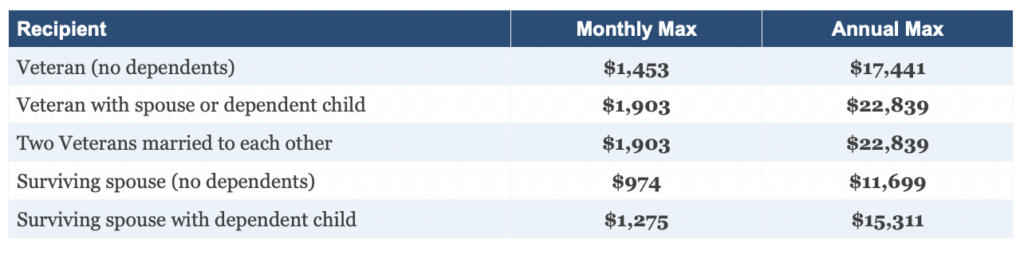
2026 Benefit Rates at a Glance
Effective December 1, 2025 through November 30, 2026 (tax-free monthly maximums):
Who Qualifies?
To be eligible for Aid & Attendance, a veteran or surviving spouse must generally meet all three of the following criteria:
- Service History: The veteran must have served at least 90 days of active duty, with at least one day falling during a recognized wartime period (World War II, Korean Conflict, Vietnam Era, or Persian Gulf War). The veteran does not need to have served in a combat zone.
- Medical Necessity: A physician must certify that the individual requires assistance with Activities of Daily Living (ADLs) such as bathing, dressing, medication management, or meal preparation, or that a cognitive condition requires ongoing supervision for safety.
- Financial Eligibility: The 2026 net worth limit is $163,699, which combines countable assets and annual income. Importantly, the primary residence and one vehicle are excluded from this calculation. Unreimbursed medical expenses, including home care costs, can significantly reduce countable income and increase the benefit amount.
What Can the Benefit Be Used For?
Because the benefit is paid directly to the veteran or surviving spouse, it is remarkably flexible. Funds can cover:
- Personal care and assistance with daily activities
- Homemaker services (light housekeeping, laundry, meal preparation)
- Companionship and supervision for those with memory-related needs
- Transportation to medical appointments
- Medication reminders and health monitoring support
- Home modifications that support safe, independent living
How to Apply
Applications are submitted through a local VA Regional Office. Because the paperwork can be complex, particularly when documenting unreimbursed medical expenses to maximize the benefit, and many families choose to work with a Veterans Service Officer (VSO) at no cost, or with a VA-accredited claims agent. Once approved, the benefit is often paid retroactively to the date the application was first filed.
A key first step: make sure the veteran is enrolled in VA health care, even if they have Medicare or private insurance. Enrollment opens the door to a broader range of VA-administered services beyond the pension benefit alone.
Did You Know?
In addition to the Aid & Attendance benefit, many enrolled Veterans may qualify for Homemaker, Home Health Aide, or Respite Care services through the VA healthcare system. These programs can provide assistance with personal care, homemaking, companionship, and caregiver relief while allowing Veterans to remain safely at home.
This is an important distinction: these VA healthcare services are separate from the pension benefit and do not require Aid & Attendance approval. Veterans who are already enrolled in VA health care may be eligible for in-home support right now. If you are unsure which VA benefit may be available, our team would be happy to help point you in the right direction.
At Timesavers, we have the privilege of serving Veterans every day. We know that asking for help isn’t always easy, and navigating benefits can feel overwhelming. Our goal is to make the process simpler and help families find the support they deserve. After a lifetime of service to our country, Veterans deserve care, dignity, and the opportunity to age safely at home.
This article is provided for informational purposes only and does not constitute legal or financial advice. Benefit rates are effective December 1, 2025, through November 30, 2026. Individual benefit amounts are determined by the VA based on verified income, assets, and care documentation.